

What Are Advanced Diagnostic Labs & Blood Bank? The Science Behind Every Diagnosis
What Are Advanced Diagnostic Labs & Blood Bank? The Science Behind Every Diagnosis
Behind every prescription and treatment plan is a test result that confirmed what's actually going on inside the body. A hospital's diagnostic lab is where blood, fluid, and tissue samples are analyzed to detect infections, monitor organ function, and guide treatment decisions — while the blood bank stores and manages the blood products that patients depend on during surgery, delivery, or a medical emergency.
Why These Two Units Matter Together
Diagnostics and blood supply sit at the center of almost every serious case a hospital handles. Together, they support things like:
- Confirming infections such as Hepatitis, HIV, Dengue, or COVID-19
- Monitoring chronic conditions like diabetes and thyroid disorders
- Checking organ function through liver and kidney tests
- Screening for hormonal, autoimmune, and tumor markers
- Providing safe, ready blood and plasma for surgery, delivery, or trauma
What Happens Behind the Scenes
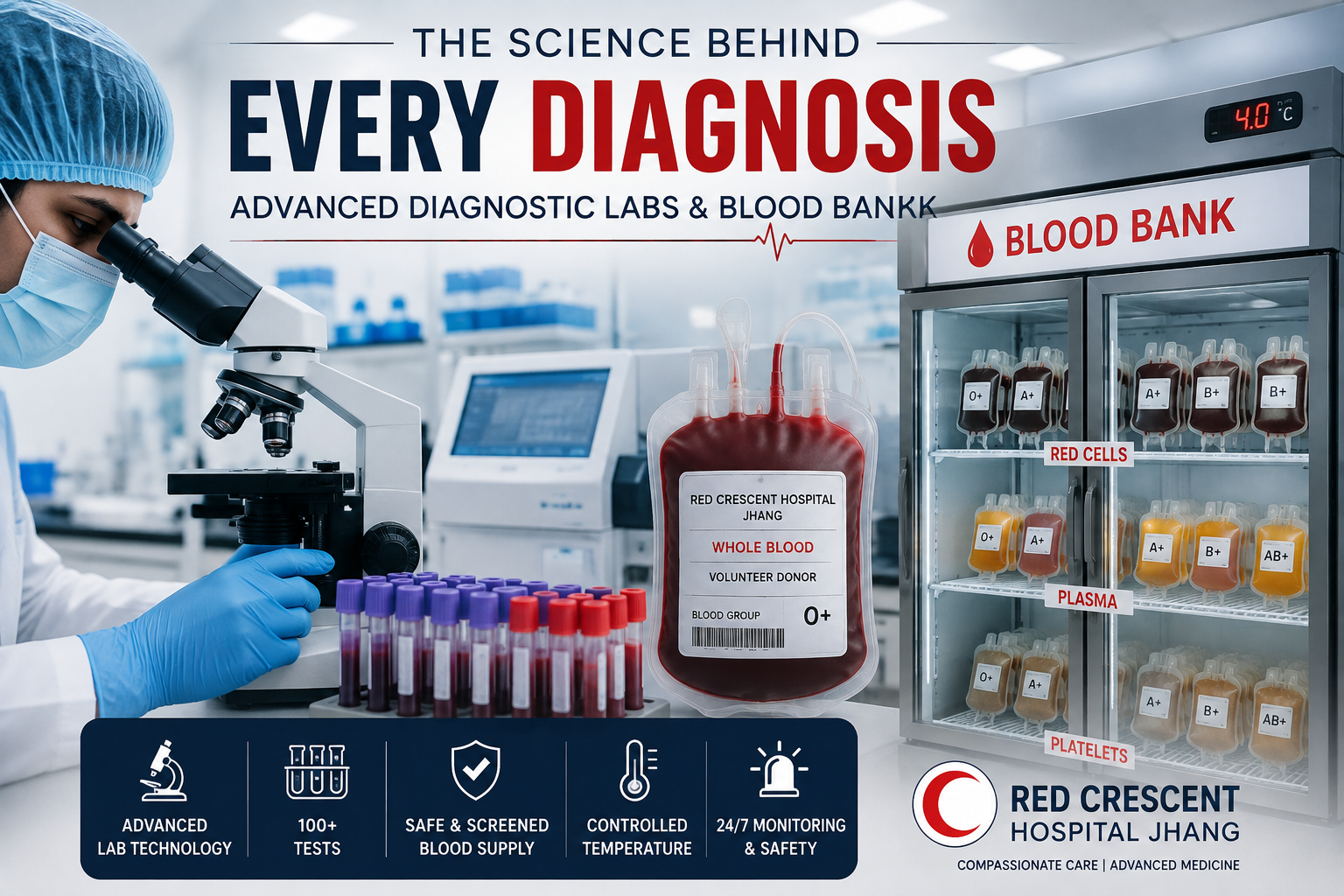
A modern diagnostic lab runs on a range of specialized analyzers — chemistry, hematology, coagulation, and electrolyte analyzers — each built to process a different type of test quickly and accurately. A single blood sample can be screened for over a hundred different markers, from infectious diseases to cardiac and cancer indicators, giving doctors a clear, fast picture of a patient's condition.
The blood bank runs on equally precise standards. Blood is stored in dedicated refrigerators at controlled temperatures, plasma is kept frozen well below zero, and platelets are held in agitated incubators to stay usable. Continuous temperature monitoring with alarms ensures nothing in storage is ever compromised — because blood that isn't stored correctly can't be trusted when it's needed most.
|
“A diagnosis is only as good as the test behind it — and blood, when it's needed, can't wait for tomorrow.” — RED CRESCENT HOSPITAL JHANG |
Why It Matters
Fast, accurate diagnostics shorten the distance between a symptom and the right treatment. And a well-managed blood bank means that when a mother needs blood after delivery, or a patient needs it during surgery, there's no delay waiting for supply — it's already there, tested, and ready.
Diagnostic Lab & Blood Bank Facilities at Red Crescent Hospital Jhang
- Chemistry, Hematology, Coagulation & Electrolyte Analyzers
- 100+ tests, including infectious disease & hormone screening
- Blood refrigerators (2–6°C) & plasma freezers (-30°C or lower)
- Platelet incubators with agitators
- Continuous temperature monitoring & alarms
